How to Read Fiber on Nutrition Labels: Essential Guide

Packaging loves the word “fiber.” Made with whole grains, it is an excellent source of fiber and boosted with prebiotic fiber. Reading the actual label takes 10 seconds and shows how to read nutrition label fiber.

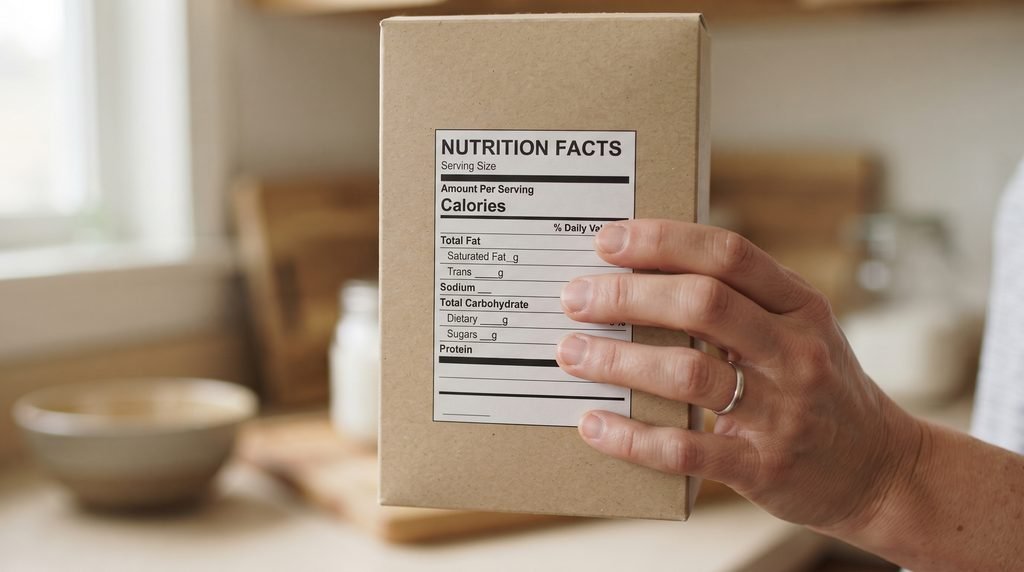
Step 1: Find “Dietary Fiber” under Total Carbohydrate

On a U.S. nutrition label, fiber is listed under Total Carbohydrate, alongside sugars. This shows how to read nutrition label fiber in practice. This is the only number that matters; ignore front-of-package claims entirely and go straight here.
ind "Dietary Fiber" under Total Carbohydrate

Step 2: Check the serving size before the fiber value

This is where most people get misled.

A cereal might list 5g fiber, but the serving size matters.

If you usually eat one cup but the serving is 1.5 cups, you may get less.

This shows how to read nutrition label fiber clearly.

Always check serving size and fiber grams together, not the fiber number in isolation.

Step 3: Use this rough scale to judge what you’re looking at

  • Under 1g per serving: Not a meaningful fiber source, regardless of packaging claims.
  • 2.5–4.9g per serving: A “good source” of fiber — worth including but not a fiber powerhouse.
  • 5g or more per serving: An “excellent source” — genuinely worth prioritizing.

These thresholds roughly mirror how the FDA defines “good source” and “excellent source” claims. If you see a “good source of fiber” label, you know that means somewhere in the 2.5–4.9g range, not a huge amount.

Step 4: Watch for “isolated” or “added” fiber

Some products boost their fiber number with isolated fibers like inulin or chicory root extract.

They are added to hit a marketing threshold.

This isn’t necessarily bad, but it behaves differently than fiber from whole foods.

Inulin tends to cause more gas, and added fiber lacks vitamins and minerals.

Check ingredients: if fiber is high and first ingredients are refined flour and sugar, it’s fortified junk food.

Think about how to read nutrition label fiber when evaluating such products.

A quick real-world example

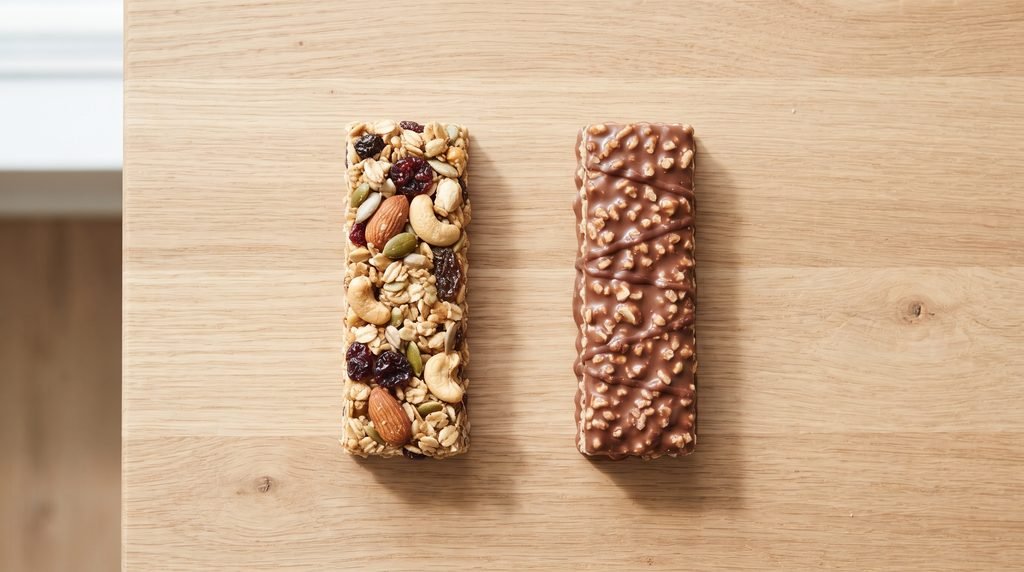
Compare two granola bars.

Bar ABar B
Serving size1 bar (40g)1 bar (35g)
Fiber5g3g
First ingredientRolled oatsSugar

Bar A wins clearly. It has higher fiber, a smaller serving, and the ingredient list confirms it is built around a genuine whole-grain base rather than fortified after the fact.
The one habit that actually matters

The one habit that actually matters

You don’t need to memorize any of these numbers.

A simple habit helps with how to read nutrition label fiber.

Before a packaged food goes in your cart because it looks healthy, flip it over.

Check dietary fiber against the serving size.

That single check filters out most of the marketing noise instantly.

Is Too Much Fiber Bad for You? Here’s Where the Line Actually Is

Fibermaxxing content (including some of what we’ve written here) leans hard into “eat more fiber” as universal advice — and for the vast majority of people who are under-eating fiber, that’s genuinely correct. But “more is better” has a ceiling, and it’s worth knowing where it is before you start treating 60+ grams a day as a personal record to beat.

What actually happens if you overdo it

What actually happens if you overdo it

Beyond a certain point, excess fiber intake can cause:

  • Bloating and gas, especially if the increase happened quickly rather than gradually
  • Reduced mineral absorption. Very high fiber intake, particularly from supplements, can modestly interfere with the absorption of minerals like iron, zinc, and calcium
  • Intestinal blockage in rare cases, particularly if fiber intake is very high while water intake is low — this is uncommon but is why doctors emphasize hydration alongside any fiber increase
  • Unintended weight loss or reduced appetite if fiber intake becomes so high that it crowds out other necessary nutrients

So what’s actually “too much”?

There isn’t a hard universal number, but most guidance suggests that intakes above roughly 70 grams a day, sustained over time, start moving from “beneficial” into “diminishing returns and possible downsides” territory for most adults. For context, that’s nearly double the standard recommendation of 25–38 grams — meaning the overwhelming majority of people fibermaxxing today are nowhere near this ceiling, even those trying hard to increase their intake.

The real-world risk isn’t the ceiling — it’s the pace

In practice, almost nobody accidentally eats 70+ grams of fiber sustainably through whole foods alone; it takes real deliberate effort. The actual problem most fibermaxxers run into isn’t a dangerously high total, it’s increasing too fast — going from 15g to 35g in a few days rather than over a few weeks. That’s a pacing issue, not a “fiber is dangerous” issue (see our guide on fibermaxxing side effects for exactly how to manage that transition).

Who should be more cautious

A few groups should be more careful about aggressively maximizing fiber intake:

  • People with a diagnosed digestive condition (IBS, IBD, diverticulitis) — fiber type and amount can meaningfully affect symptoms and should be personalized with a doctor
  • People on certain medications, since fiber can affect how some drugs are absorbed
  • People prone to mineral deficiencies, who may want to space out fiber-heavy meals from mineral-rich meals or supplements
For the average person actively trying to hit a 25–38 gram daily target, "too much fiber" isn't a realistic concern.

The bottom line

For the average person actively trying to hit a 25–38 gram daily target, “too much fiber” isn’t a realistic concern. The much more common — and much more fixable — issue is increasing too quickly rather than increasing too much. Pace it out, drink water, and the ceiling this article describes is unlikely to ever become relevant to you.

Fibermaxxing Side Effects: Why You’re Bloated and How to Fix It

Why it happens

If you jumped into fibermaxxing enthusiastically and now feel like a balloon, you’re not doing it wrong — you’re just doing it too fast. Bloating, gas, and mild stomach discomfort are the most common reasons people quit high-fiber diets in the first week, and almost all of it is avoidable.

Psyllium is a soluble, gel-forming fiber — it absorbs water and turns into a thick gel in your gut.

Your gut bacteria ferment fiber as it passes through your digestive system, and that fermentation process produces gas as a natural byproduct. If your gut hasn’t adapted to a higher fiber load yet, that fermentation happens faster and more intensely than your body is used to — hence the bloating.

This isn’t a sign that fiber is “bad” for you or that something is wrong. It’s closer to what happens when someone who never exercises suddenly runs five miles — the discomfort is a sign of a sudden change, not necessarily a permanent problem.

The most common mistake: going from 15g to 40g overnight

Most people underestimate how big a jump this actually is. If you’re used to eating 12–15 grams of fiber a day and suddenly add a fiber supplement plus several high-fiber meals, you could be tripling your intake in a single day. Almost nobody’s gut handles that smoothly.

How to fix it

  1. Increase gradually, not all at once. Add roughly 5 grams every 3–4 days rather than jumping straight to your full target. It’s slower, but it’s the difference between sticking with fibermaxxing and quitting after one uncomfortable weekend.
  2. Drink more water than usual. Fiber — especially soluble fiber — needs water to do its job properly. Without enough fluid, added fiber can actually make constipation worse, not better.
  3. Favor whole foods over supplements at first. Whole foods tend to be gentler than concentrated fiber supplements or powders, partly because you’re also getting water content and other nutrients alongside the fiber.
  4. Watch out for high-FODMAP fiber sources if you’re sensitive. Foods like beans, inulin-based supplements, and certain vegetables ferment quickly and can cause more gas than others. If you’re particularly sensitive, start with gentler sources like oats, chia, and cooked (not raw) vegetables.
  5. Give it two to three weeks. Most people’s gut bacteria genuinely adapt to a higher fiber intake within a few weeks, and the bloating that was intense in week one is often gone by week three.
People focused specifically on gut microbiome health rather than digestive bulk

When to actually see a doctor

Mild, temporary bloating in the first couple of weeks is normal. Persistent pain, blood in your stool, unexplained weight loss, or symptoms that don’t improve after a few weeks of gradual increases are not “just fiber adjustment” — those warrant a conversation with a doctor, especially if you have a pre-existing condition like IBS, Crohn’s disease, or diverticulitis.

The bottom line

Bloating is usually a pacing problem, not a fiber problem. Slow the ramp-up, drink more water, and give your gut time to catch up — most people who push through the first two weeks report that the discomfort fades almost entirely.